Image
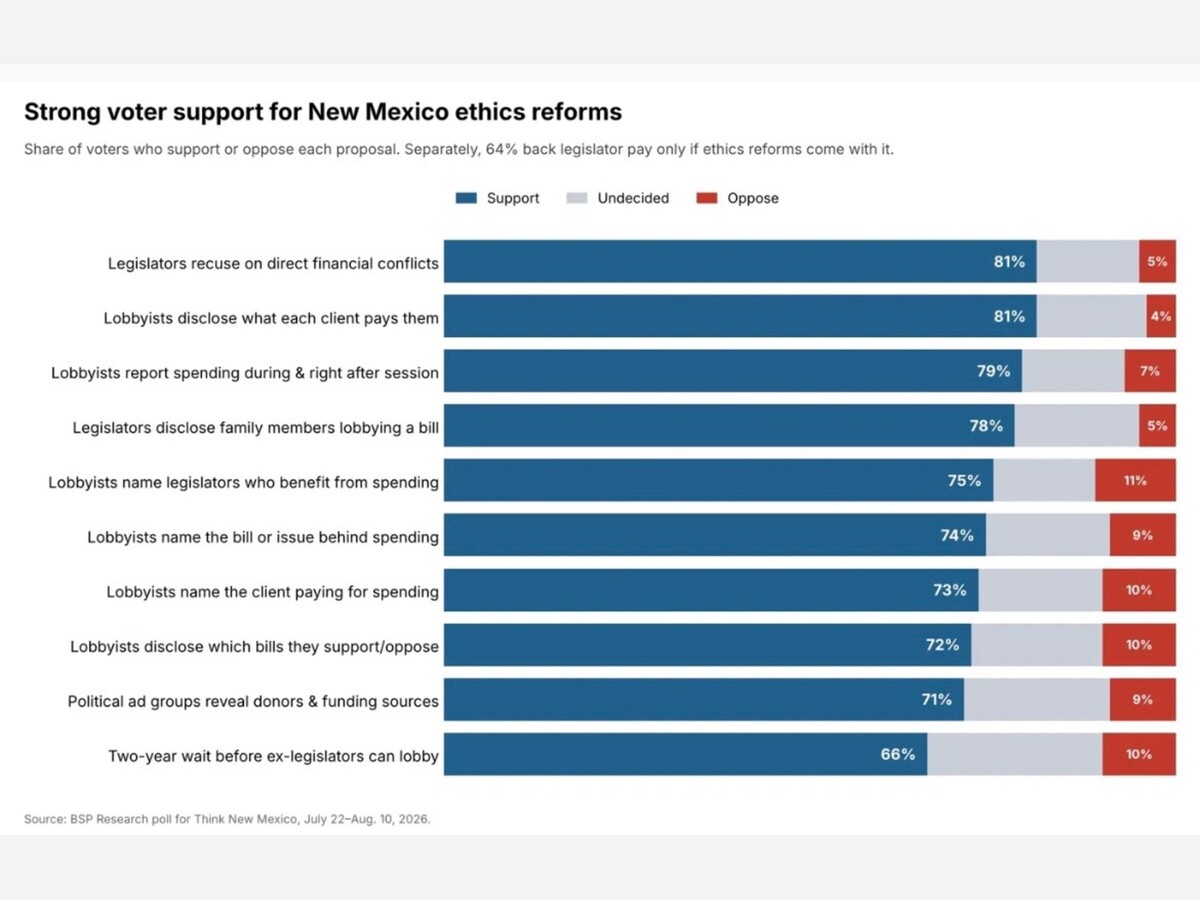
SANTA FE — New Mexico legislators will start drawing salaries in 2029, but the measure voters approved Nov. 3 adds no ethics rules to go with the money. A new report from Think New Mexico lays out the guardrails that are missing.
The Santa Fe think tank's new report lays out four groups of reforms: mandatory disclosure and recusal on conflicts of interest, a two-year wait before former lawmakers can lobby, broader lobbyist disclosure, and new rules on dark money and fake constituent messages.
Constitutional Amendment 4 passed roughly 62% to 38% in preliminary returns. It ties pay to the state's median household income, about $68,000, ending New Mexico's status as the last state with an unsalaried legislature. The amendment sets pay only; it contains no new rules on conflicts of interest, outside income or lobbying.
That gap is the concern Alamogordo Town News raised before the election. Its editorial board urged a no vote on Oct. 27, arguing the amendment wrote a paycheck without defining the job or the ethics standards that should come with it.
Think New Mexico's report reaches a similar conclusion: states that pay legislators generally hold them to stricter rules, and New Mexico's volunteer status has long been the excuse for loose ones.
It also points to recent scandals. On Aug. 14, former House Majority Leader Sheryl Williams Stapleton was convicted of 31 federal felonies, including bribery and money laundering, for diverting more than $2 million in education funds meant for Albuquerque students. A 2025 Garrity Group survey found only 19% of New Mexicans trust state government officials, down from 31% in 2020.
A BSP Research poll commissioned by the group, conducted July 22 to Aug. 10, found 64% of voters back paying legislators only if mandatory ethics reforms come with it.
Alamogordo Town News editor Chris Edwards laid out the case against Amendment 4 in an Oct. 27 commentary. The amendment, he wrote, sets a salary for 112 legislators without defining the work it pays for.
Nothing in the measure requires minimum hours, town halls, district offices, constituent-service standards or attendance at interim committees. It places no limit on outside income, so a member could collect the full salary while keeping a full-time career.
The commentary also put a price on the job:
About $65 an hour. Supporters cite a self-reported average of 20 hours a week. At roughly $67,800 a year, that works out to about $65 an hour.
Nearly $90,000 a year. Legislators keep their $247-a-day per diem, mileage and pension. In a 60-day session year, salary plus session per diem reaches $82,620, and passes $87,500 with 20 interim committee days.
Room for more. The amendment deletes the constitutional ban on other "perquisites or allowances," letting a future Legislature add benefits for itself.
The editorial board called for a new amendment next session that defines the job, addresses outside employment and conflicts of interest, and lets an independent citizens commission set pay.
Think New Mexico's package answers the conflict-of-interest piece of that critique. It does not address minimum duties or who sets legislative pay, which Town News flagged as equally urgent.
The centerpiece is a constitutional amendment requiring salaried legislators to recuse themselves from bills in which they have a direct financial stake, without needing their colleagues' permission.
Under current House and Senate rules, a lawmaker cannot simply recuse. The chamber must vote to excuse them. The report counts New Mexico among just nine states where recusal is discouraged, while 36 states expect it. Colorado, Oklahoma and Texas write the requirement into their constitutions.
The group wants a constitutional change rather than a statute because a February 2026 State Ethics Commission advisory opinion said each chamber controls its own members' voting, leaving a law open to challenge.
The test would be whether a bill helps or hurts a legislator more than the public at large. A teacher-legislator could vote on the overall education budget but not on a bill raising retired teachers' pensions.
The report also calls for:
Requiring legislators to disclose financial conflicts before acting on a bill, as 43 states do, following Colorado's model.
Requiring disclosure when a spouse, parent, child or sibling is paid to lobby on a bill, as the Ethics Commission has recommended, and recusal when the lobbyist is a spouse.
Rewriting the Financial Disclosure Act so officials name the specific businesses and assets behind income over $5,000, instead of broad categories like "investment income," and report honoraria and debts. Dollar amounts would stay private.
Polling found 81% support for recusal on direct conflicts and 78% for disclosing family members' lobbying.
The second proposal would bar former legislators from lobbying for pay for two years after leaving office. Today, a lawmaker could legally resign mid-session and be paid to lobby former colleagues the next day.
Thirty-seven states have such waiting periods, most of one or two years. Florida's is six. Members of Congress have been covered since 1989, and New Mexico executive branch employees have faced a one-year ban since 1993. The report would lengthen that executive branch ban to two years for consistency.
The idea has drawn bipartisan support before. A 2017 two-year ban passed the House 58-2 but died in the Senate Judiciary Committee, and Sen. Harold Pope has introduced versions in 2023, 2025 and 2026. Former Govs. Bill Richardson, a Democrat, and Susana Martinez, a Republican, both backed it.
The ban would not stop former lawmakers from advocating unpaid. Sixty-six percent of voters supported it; 10% opposed.
Registered lobbyists outnumber New Mexico legislators about six to one, and their reported spending hit a record $1.25 million by October 2025. Yet the Center for Public Integrity gave the state an F for lobbying disclosure, ranking it 43rd.
The report cites filings that reveal little. One lobbyist with 19 clients reported $22,710 spent on flowers for legislators. Another listed 31 restaurant meals for "various legislators and staff" without naming clients or bills.
Think New Mexico proposes four changes to the Lobbyist Regulation Act:
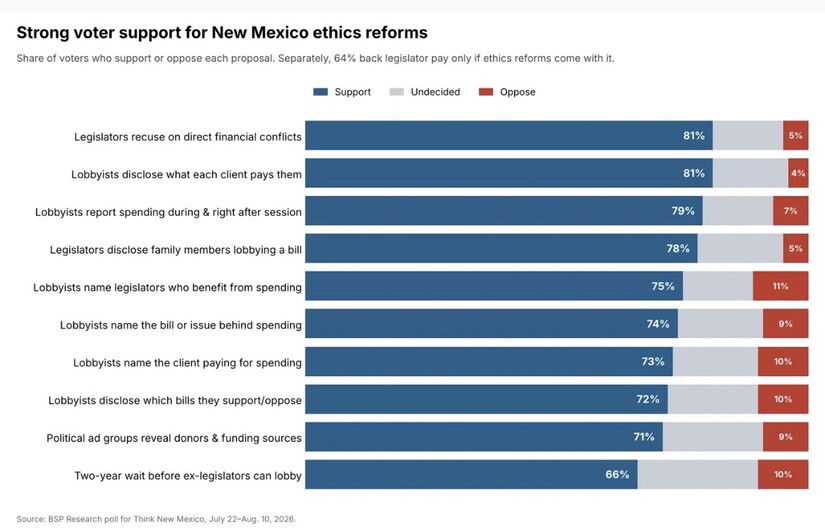
The report estimates lobbyists received more than $7.8 million in unreported pay in 2025, based on national ratios of compensation to spending.
The bill-tracking idea came close in 2025. House Bill 143, sponsored by Rep. Sarah Silva and Sen. Jeff Steinborn, passed both chambers but was vetoed by the governor. Colorado requires lobbyists to disclose a bill position within 72 hours.
State law requires groups that buy political ads to disclose their donors, but only their direct donors. The report shows how that leaves voters guessing.
New Chapter New Mexico PAC spent $438,198 in the 2026 primary; its only contributor was a nonprofit of the same name, which need not reveal its funders. Accountable New Mexico got 88.7% of its $975,500 from one nonprofit. Elevate New Mexico, which ran ads for the Project Jupiter data center, drew all of its $3.67 million from a single LLC.
The group proposes a "true source" law modeled on Arizona's Voters' Right to Know Act, approved by 72% of Arizona voters in 2022 and upheld by that state's Supreme Court in June. Big spenders would name donors over $5,000, and those donors would name their own funders until the original source is reached. Ads would list their top three donors and the share of out-of-state money. It would cover both campaign and issue ads.
The report also recommends:
Seventy-one percent of voters supported requiring ad sponsors to report their funding sources.
Most of the proposals could be passed as ordinary bills in the 60-day legislative session that opens in January. The recusal requirement would need lawmakers to put another constitutional amendment before voters.
Many of the ideas have stalled before, often in Senate committees. The report argues that the new salaries change the calculus, and that the State Ethics Commission already endorses several of the reforms. The group frames the package as bringing New Mexico in line with what most states already require.
Think New Mexico, a nonpartisan think tank founded in 1999, says it accepts no government funding. The report notes that it was researched and written without artificial intelligence.


Sunny, with a high of 68 and low of 46 degrees. Sunny for the morning, clear in the afternoon and evening,