77° and Overcast
Image
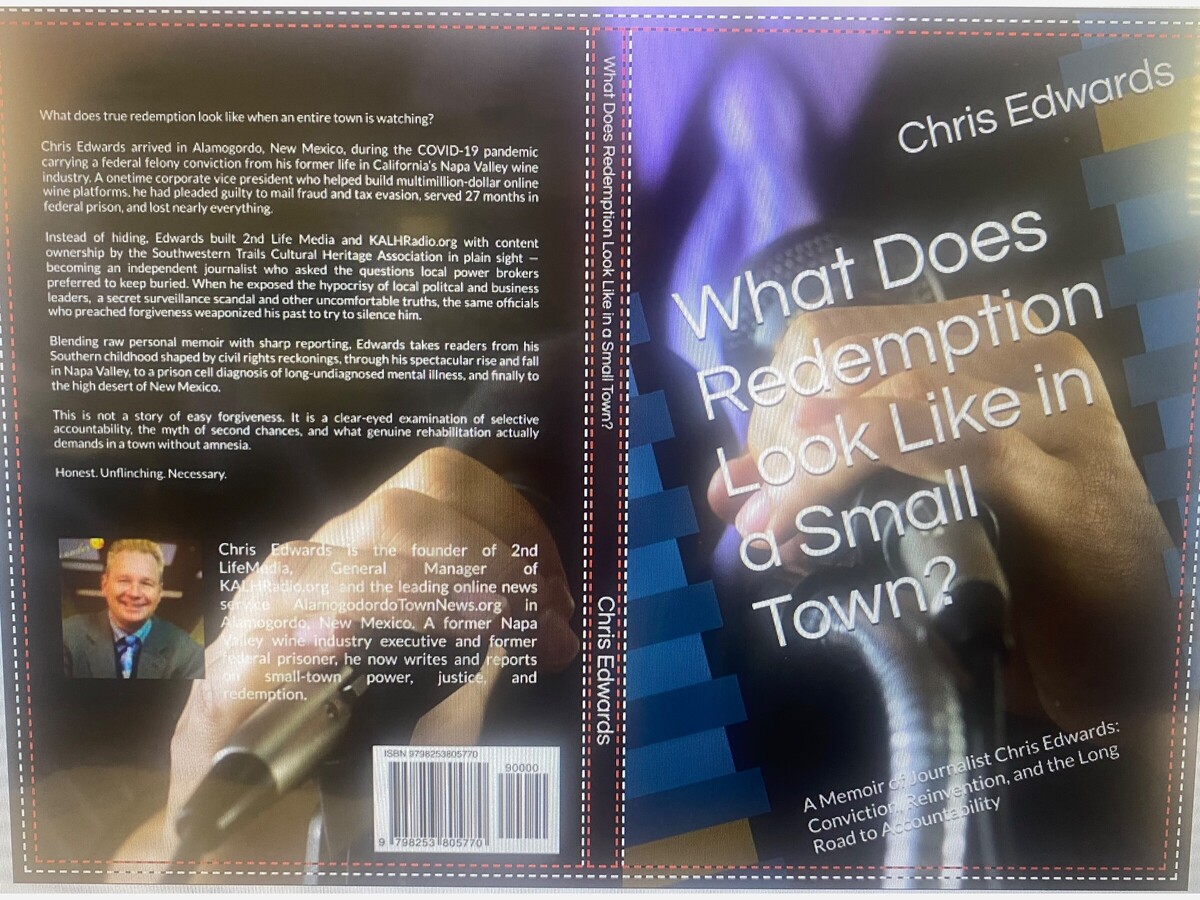
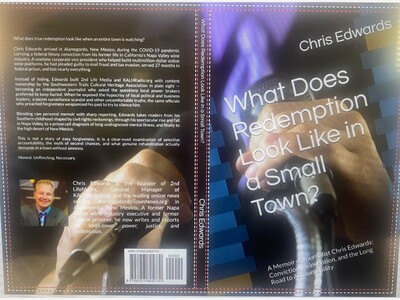
Alamogordo Journalist Chris Edwards Releases New Memoir “What Does Redemption Look Like in a Small Town?” A Raw, Unflinching Examination of Conviction, Mental Illness, and Selective Forgiveness in the High Desert



ALAMOGORDO — On the same day he turns the page to a new chapter in his own story, local radio host, journalist, and 2nd Life Media founder Chris Edwards has published his most personal work yet: What Does Redemption Look Like in a Small Town? A Memoir of Conviction, Reinvention, and the Long Road to Accountability.
The 169-page memoir, released today through 2nd Life Media and available in paperback, Kindle, and audiobook on Amazon, is far more than a personal confession. It is a sustained meditation on what genuine second chances require when they are lived under the unforgiving spotlight of a town of 30,000 where “everyone eventually learns everyone else’s business.”
Edwards does not ask for sympathy. He asks a harder, more uncomfortable question—one that echoes from the prologue through every chapter: In a community that loudly champions faith, forgiveness, and redemption, why is that grace so selectively applied to those who challenge power?
The book opens with Edwards’ childhood odyssey across the American South in the 1960s and ’70s. Born in Shawneetown, Illinois, and raised in towns like Vicksburg, Mississippi; Tulsa, Oklahoma; Memphis, Tennessee; Florence, Alabama; and Clarksville, Tennessee, he witnessed cross-burnings, school integration battles, and the cost of principled stands. His father hired the first Black assistant manager at the local Woolworth’s; the Ku Klux Klan responded by burning a cross on the family lawn. His mother’s whispered lesson—“Never let fear drive you to silence”—became a lifelong refrain.
Those early chapters read like a master class in moral formation. Edwards writes with quiet power about learning that “silence is complicity” and that “the person who stays in the room changes what the room becomes.”
The narrative then shifts to his twenty-five years in California’s Napa Valley wine industry. A self-made executive who helped pioneer online wine sales (Virtual Vineyards → wine.com → The WineTasting Network, later sold to 1-800-Flowers), Edwards rose to corporate vice president and general manager. He ran for Napa City Council, volunteered, read poetry at weddings, and built the kind of polished life that looked like the American dream.
Then it collapsed.
In late 2010, under the pressure of undiagnosed clinical depression, anxiety, and bipolar conditions, Edwards created a fictitious entity and directed nearly $894,000 in improper payments to himself while serving as an officer of a publicly traded company. He pleaded guilty in 2014 to mail fraud and tax evasion, received a 33-month sentence (served 27 months), and returned to the United States from Mexico in handcuffs after a failed attempt to negotiate his surrender.
The memoir does not flinch from these facts. Edwards calls his actions “unethical” and “a cry for help” in the same breath that he describes the chemical imbalance that shaped—but did not excuse—his choices. The diagnosis and treatment he finally received in federal custody become a pivotal turning point.
The heart of the book, however, is not California or prison. It is Alamogordo.
Edwards arrived in the high desert during the COVID-19 pandemic and built 2nd Life Media and KALH Radio from the ground up. He began asking questions—about the Alamogordo Chamber of Commerce’s secret recording of private conversations and internal ethics crisis, about school board governance, about city transparency. The response, he writes, was predictable: the same officials who invoke Christian forgiveness recirculated his federal record whenever his reporting became inconvenient.
In the prologue, Edwards sets the scene with surgical precision:
“On a bright October morning in the high desert of southern New Mexico, I sat at my desk at KALH Radio on New York Avenue and read something that made me set down my coffee. It was another attack… The source, as usual, was a coalition of local officials, school board figures, chamber leaders, and political operatives who had decided, once again, that the most effective way to silence a reporter asking inconvenient questions was to remind everyone who he used to be.”
The memoir becomes both personal reckoning and civic indictment. Edwards argues that small towns do not make redemption easier—they make it visible. And visibility, he writes, is the ultimate test of character: “If a person can only behave well when no one is watching, that is not character. Character is what you do when the whole town is watching, and many of them are waiting for you to fail.”
What Does Redemption Look Like in a Small Town? is a remarkably disciplined memoir. Edwards resists the twin temptations of self-pity and self-congratulation. The prose is clean, journalistic, and often lyrical—especially in the Southern chapters—yet never ornamental. He lets the facts, the contradictions, and the hypocrisies speak for themselves.
The most powerful sections are those that refuse easy resolution. Edwards acknowledges errors in his present-day journalism as readily as he owns his past crimes. He does not demand that Alamogordo forgive him; he demands that the community examine its own selective application of grace. That honesty elevates the book beyond personal memoir into something broader: a case study in America’s broken reintegration system.
Readers familiar with Bryan Stevenson’s Just Mercy or Tara Westover’s Educated will recognize the same clear-eyed refusal to sentimentalize hardship. Edwards writes as both participant and reporter, insider and outsider. The result is a narrative that feels urgent and deeply local while addressing national questions about criminal justice, mental health, and second-chance policies.
At times the book stings—particularly when Edwards contrasts the public rhetoric of local leaders with their private tactics. Yet it never descends into score-settling. The final chapters offer a measured blueprint for “Second-Chance America,” grounded in the author’s own ongoing work rather than abstract theory.
Rating: 4.5 out of 5 stars Strengths: Brutal honesty, vivid storytelling, timely local relevance. Minor critique: Some readers may wish for deeper engagement with the perspectives of his critics; Edwards acknowledges the gap but keeps the focus on his own accountability.
What Does Redemption Look Like in a Small Town? is now available on Amazon in paperback (6×9), Kindle, and audiobook formats. Signed copies will be available at select local events and through 2nd Life Media.
For Edwards, the book is not the end of a story but another step on a road that remains unfinished.
“I have rebuilt in the open,” he writes. “And every time I ask a question powerful people would rather not answer, the same paragraphs about my past recirculate. This book is my answer—not just for myself, but for every person trying to prove they are more than their worst moment.”
Whether Alamogordo—and the rest of us—are ready to grapple with that answer remains to be seen.
Buy the book: Search “What Does Redemption Look Like in a Small Town” on Amazon



Sunny, with a high of 83 and low of 64 degrees. Sunny for the morning, overcast in the afternoon, clear overnight.